The Erasure Of People of Colour (POC) Identity Within Western Paintings
My history was looking back at me, but we were both thousands of miles away from where we came from. We were both in a British museum and estranged from our history. It took me three visits to comprehend the painting, even though it covered over half of the wall, begging to be seen.
The first visit
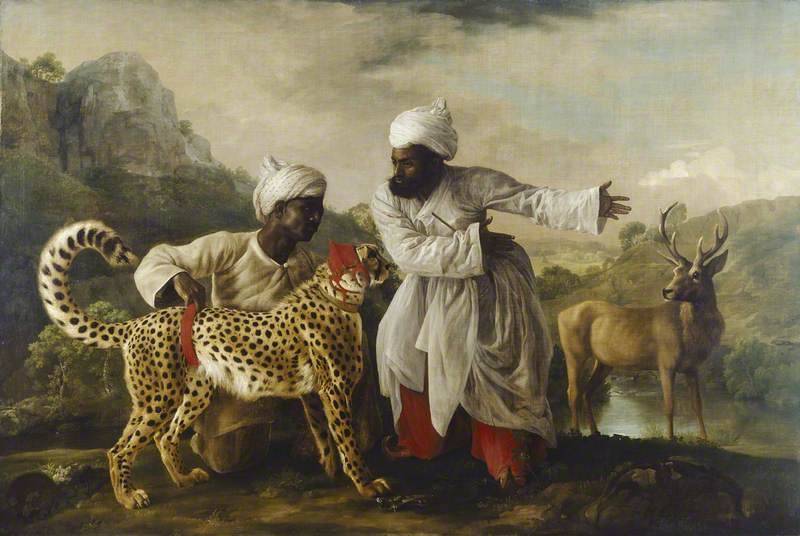
When attending the Manchester Museum, I walked past the painting at the end of my visit and didn’t pay mind to it. It was fairly unusual, with the brown attendees being the only two humans in the painting, heavily detailed, in the centre. They were huge and central, surrounded by scenic hills and magnificent animals, reigning them in, subduing the powerful cheetah and looked upon by a stag, and detailed in a way only portraits of aristocrats usually were. It was huge, but it wasn’t what I was conditioned to like, so I skimmed the plaque and dismissed it.
It was so abnormal, because ‘normal’ paintings with people of colour are usually featured tending to their white masters or in the background in a shroud of darkness. Take the ‘Banquet of a rich glutton’ by Josef Danhauser (1836) as an example, which features a beggar entering the home whilst the occupants gorge themselves on food. A black servant holding a bottle in the far left of the painting is not mentioned in the description. In fact, it's not mentioned at all when I looked for the context of the painting in any catalogue or on the internet. The painting itself highlights the white occupants, the beggar taking up a quarter of the painting, but the servant shares their space with a heavy curtain and is shadowed by it. Their colours are also very contrasting. With the light-coloured fabrics draped over the wealthy at the table and the beggar in a range of colours just less vibrant; the servant is in a muted blue and mustard, and is covered in a shadow, only visible up close. I had also noticed that POC in paintings are nameless and are made to serve no purpose but to only be used by the artist as an accessory and a way to uphold socio-political views of the ‘others’ place. Although in ‘A cheetah and a stag with two Indian attendants’ George Stubbs allowed the Indian attendants to be front and centre, he didn’t allow their humanity to show by making them nameless. Names have very important ties to identity, and so having no records of names, they are stripped of any way of getting to know them and finding their history.
Seeing that, even to this day, there has been no attempt to find out who these attendees are, there is a huge gap missing when discussing the historical impact of POC within the British Empire. The narrative of the story behind the painting mentions them, stating their role in releasing the stag and the cheetah. And after the cheetah was bested by the stag and escaped the royal paddock to hunt a deer, the servants caught up to it, they hoodwinked the animal, fed it part of the deer then led it away. Even though George Stubbs didn’t make a caricature of the attendants, the fact that there is no record of how they came upon the cheetah for King George III or how they became the attendants of England’s first big cat species at the time.
Race other than white in art is always depicted as lesser, in all forms of art, especially during Victorian England. They only serve as symbols of oppressed power. They are barely clothed, entertainers or in domestic service. And so when I got used to depictions like that, ‘A cheetah and a stag with two Indian attendants’ was something that inspired me with awe, but with uneasiness at the unfamiliarity.
The second visit
I went a second time to the Museum with a friend, and I showed her all my favourite paintings. Like the ones of a woman looking out into the sea for her lover who swam every day to see her and hadn’t appeared as dawn was breaking behind her. The ones where the whole wall was taken over with horses' bulging eyes in the forefront of a chariot race. As we swept through the halls, at the end of our visit, we rushed past and glanced at ‘A cheetah and a stag with two Indian attendants’, and again, it filled me with an uncomfortableness. But like a good little museum goer, I read the plaque, properly this time, and left. And the words stuck with me.
The paintings I mainly showed her were Pre-Raphaelite paintings are predominantly found in UK museums, and Baroque paintings are commonly found globally. My friend and I are conditioned to prefer these painting styles. Learning about their history and being in all the major museums allowed for a formed bias to emerge and drew me to that painting style.
Baroque paintings (1600s-early 1700s) feature saints, kings and vivid battle scenes based on biblical or mythological scenes. They were made to astonish us by the catholic church or monarchies to show power and divinity. The art for the catholic church was made in retaliation for the protestant simple way of life. So to this day, we are overwhelmed and stunned by the theatrical pieces with dramatic lighting, striking the subjects mid-battle. And with so many pieces like this being donated by descendants of monarchies who used Baroque art to show their divine right to rule, the UK museums are oversaturated by the style. POC were again not featured heavily, only there for inaccurate portrayal or as symbols of oppressed power.
On the flip side, the Pre-Raphaelite paintings were the rebellious answer to Baroque paintings. Instead of being for the authorities of power, they were for the romantic intellectuals of their time. Founded by the Pre-Raphaelite Brotherhood, a band of young artists and poets who opposed the rigid art of the Royal Academy. Even being the rebels, they still didn’t include the importance of POC had on their way of life and society. They only featured paintings of medieval stories and legends, Shakespeare and stripped-back bible scenes. They were futurists and focused on giving people a sense of longing for natural beauty and connection to literature, but only from a Eurocentric perspective. The painting featured here is called ‘The Beloved’, which features an African child in the foreground. The painter Dante Gabriel sought out a 12-year-old model who wept when he was instructed to sit for the portrait; he reported that he was crying for ‘his Mammy’ and therefore was enslaved. Gabriel said that when he cried, his skin absorbed the tears and made them look darker. The encounter highlights the black beauty that the white artist took advantage of for his painting, again exploiting an unconsenting child of colour.
Although both styles are very different, when discussing paintings that include people of colour, they are both guilty of not portraying them in a positive light. In Pre-Raphaelite art, they were almost entirely excluded from the paintings, with some featuring only Middle Eastern individuals depicted through Orientalist stereotypes. Only a few served as subjects in these works, and those who did were portrayed in a fetishist manner. Although they were praised for their muscular bodies and features, they were only allowed to be gazed upon as novelties and denied autonomy. ‘A cheetah and a stag with two Indian attendants’ is a vastly different depiction of the usual representation, so when I visited for the second time, I wanted to see if I could spot any mockery directed toward the two men. When I couldn’t find any, I was curious about the history, but I was left with no information about the attendants. The painting was created for King George III as a homage to the first-ever cheetah brought from India and represents the best depiction of Indians without falling victim to European condescension. Stubbs allowed them to be presented with grace and was sincere in his portrayal of them.
The third visit
And then I went a third time. It was to waste time before my train. But this time, something felt different. I stopped by the painting and saw a man sitting on the couch across from it. I decided to join him. And when he left, it left only me and the painting, and it spoke to me. I think the lighting must have been different this time. The depth of their brown skin shone, their white garbs looked translucent, and the beautiful shading I’ve only seen on aristocrats or in biblical scenes.
They were out of place, that’s what inspired the uncomfortable feeling. Front and centre, they were proudly in a space amongst the other portraits of white people, but the plaques didn’t reflect the importance they seemed to hold in the painting. There is no evidence of consent whilst they are featured in the painting; there was no commission from the £120 sale. As was the norm when POC featured in works of art.
Since the abolition of slavery, most portraits were of exotic intrigue, but others were proudly painted as a justifiable way to explain the colonial history of the British Empire. For example, ‘The Secret of England's greatness’ by Thomas Jones Barker is a painting made to show Queen Victoria spreading the biblical word to an unnamed African envoy on their knees, symbolising the political climate of leaders coming to the queen for sympathy for the liberation of their people and countries. But within the painting, Queen Victoria was made not to touch the receiving hand of the envoy, meaning even though this painting was a symbol of unity for peace between countries, there were still hidden prejudices. It became socially acceptable to be an abolitionist, but there were still barriers that POC face even to this day. Even after the late 1800s, Dr Thomas John Banardo opened a rescue home for poor children in Stepney. He photographed the children in rags and looking poor and ill, and then photos were taken without consent to garner the Christian public's sympathy for poor black folk. This is still felt today, the lack of control the POC have in their depictions of themselves.
This theme of the lack of POC in the art world continues. With class and race differences, children not being able to see the representation of themselves within these spaces means that there is a lack of research in areas where it is needed. There is a severe lack of people of colour in academia, like the humanities, and because of this there is a there is a lack of representation in various industries and POC voices are still not heard. And so the painting represents the lack of control, having no bodily autonomy, where POC’s labour and skill are being exploited for the British economy and business owners. ‘A cheetah and a stag with two Indian attendants’ showed me that even though people of colour are shown, they are not heard unless they break the difficult barriers that have been in place since slavery began. And when I left the Manchester Museum, I gained a new critical eye regarding the beauty of paintings. It is imperative to have POC’s paintings displayed, but now there is a slight resentment and a newfound flame to amplify the voices lost to history.
Post a comment